
The Fentanyl Killing America is from Top Ally India — Not Venezuela
While Trump officials claim that Venezuelan President Nicolás Maduro is trafficking fentanyl to the U.S., American law enforcement reports show that the real culprit is its close ally: India.

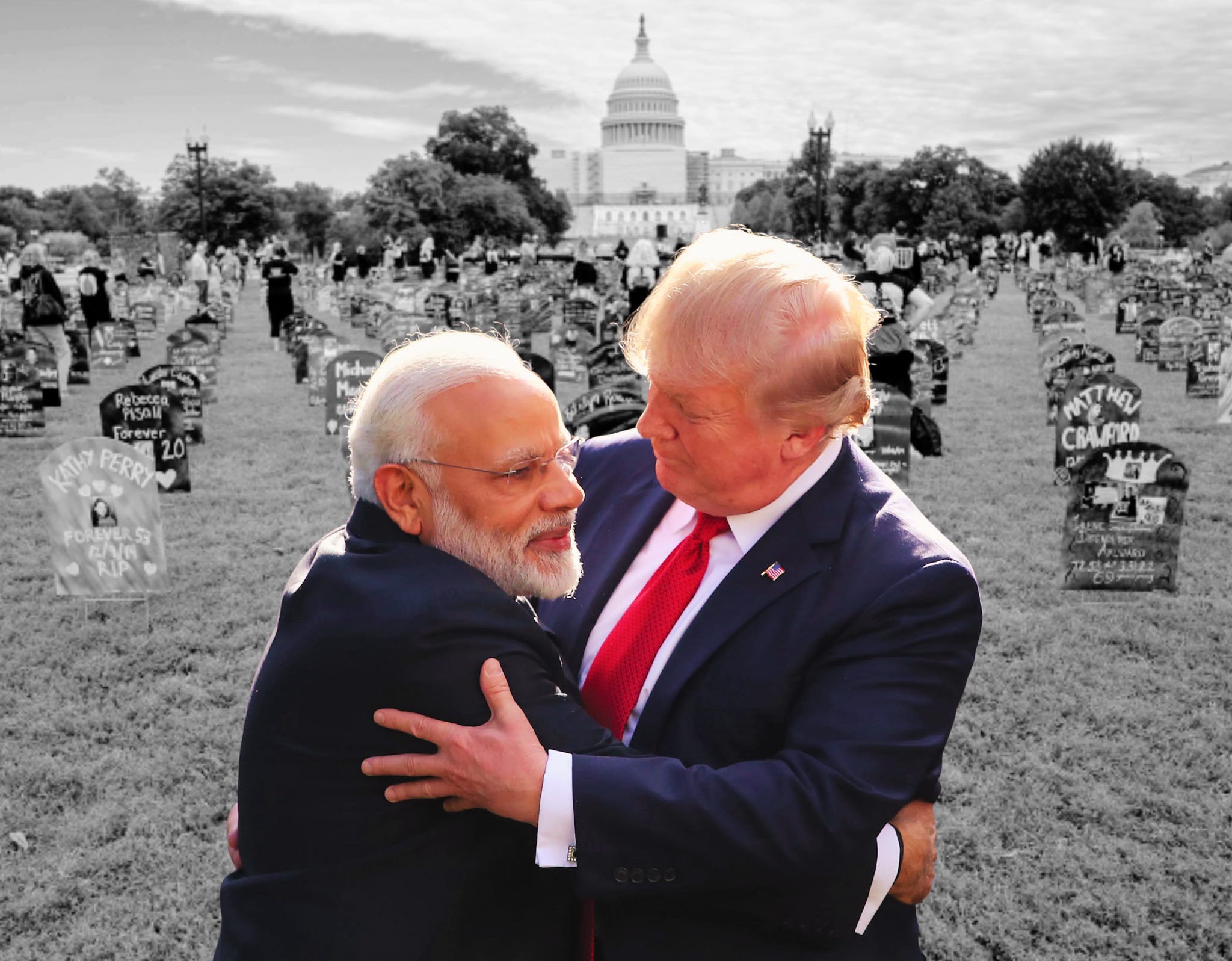
The Trump administration’s campaign of extrajudicial strikes on small boats in the Caribbean, and its broader push toward a confrontation with Venezuela, rests on an extraordinarily weak and deeply cynical justification.
After boasting in October that “every boat kills 25,000 on average,” Trump celebrated a series of strikes that left dozens dead, claiming they were disrupting fentanyl shipments headed to the United States.
This framing obscures a far more serious and uncomfortable reality. The fentanyl crisis is not only the most urgent public-health emergency in the United States; it is a mass-death event that has unfolded so slowly and steadily over decades that it has come to be treated as routine.
Since 1999, drug overdoses—especially from opioids and increasingly from synthetic opioids—have killed more than one million Americans, most of them young or middle aged. On average, 120 to 130 Americans have died from overdoses every day for a quarter century. By life-years lost, the epidemic has already surpassed the American Civil War.
Despite early signals that it might scale back foreign entanglements and normalize relations with Venezuela, the Trump administration has returned to the same bipartisan foreign-policy script that guided its failed 2019 effort to install Juan Guaidó as president. In recent months, it has advanced a narrative accusing Venezuelan President Nicolás Maduro of overseeing a state-run drug cartel known as the Cartel of the Suns. This narrative has served as the basis for a series of U.S. strikes on small vessels in the Caribbean that the administration claims are engaged in drug trafficking.
At a cabinet meeting, DHS Secretary Kristi Noem gushed over Trump’s actions, declaring that he had “saved hundreds of millions of lives” by destroying supposed cocaine shipments.
Yet outside of partisan media networks and MAGA social-media influencers, the allegations about Venezuela have not gained traction.
It is widely understood that fentanyl has mostly entered the U.S. from China and Mexico – a fact that Trump has campaigned upon and cited as a pretext for imposing tariffs on China in February, accusing the Communist Party of China “actively sustaining and expanding the business of poisoning our citizens.”
However, federal data contradicts the administration’s claims. No U.S. government report—from the DEA, the State Department, or any other agency—identifies Venezuela as a source of fentanyl. While some cocaine does transit through Venezuela, Maduro’s government is not implicated in its trafficking. Instead, it is elements of the opposition forces supported by the United States that have documented ties to criminal groups. Guaidó’s 2019 crossing into Colombia, assisted by the criminal organization Los Rastrojos, remains a stark example.
Even the Council on Foreign Relations, a central institution in U.S. foreign-policy circles, has noted that accusations linking Venezuela to fentanyl are false. The majority of the world’s cocaine production originates in Colombia, Peru, Bolivia, and Ecuador, and the principal trafficking routes run through the Pacific rather than the Caribbean.
What is largely unacknowledged—both in government assessments and across most media coverage—is that India has become a significant, and perhaps primary, source of fentanyl and fentanyl precursor chemicals entering the United States.
This is especially striking given the political and strategic importance Washington places on New Delhi, which former Director of National Intelligence Tulsi Gabbard described during a March visit to India as “the geopolitical center of gravity in the 21st century.”
India’s expanding role in the fentanyl supply chain
Fentanyl began appearing in heroin and counterfeit pills around 2013, accelerating an already deadly epidemic. China was initially the dominant supplier, but by 2016 synthetic opioids had surpassed heroin and prescription opioids as the main drivers of drug-overdose deaths.
In 2018, the Center for Strategic and International Studies warned that India—already a major producer of the synthetic opioid tramadol, which was contributing to addiction crises in Africa and the Middle East—had been slow to regulate fentanyl precursor chemicals and did not regulate fentanyl itself. The report cautioned that India’s trafficking networks were expanding and could soon emerge as major suppliers to the United States.
In 2019, China responded to U.S. pressure by enacting a sweeping, class-wide ban on all fentanyl-related substances and precursor chemicals. Beijing simultaneously launched enforcement campaigns that dramatically reduced the flow of fentanyl to the United States. The impact was immediate: U.S. Customs and Border Protection seized 314 fentanyl shipments from China in 2018, totaling 278 pounds, but only 12 shipments totaling just over 11 pounds in 2019—a 96 percent decline.
India did not take comparable action. Rather than adopt a class-wide scheduling regime, it chose to ban only the most common precursor chemicals, leaving numerous alternative precursors unregulated. This regulatory gap allowed traffickers and illicit chemists to adjust their methods with minimal disruption, creating conditions for India to assume a larger role in global fentanyl production.
Reports from the United Nations and U.S. agencies reflected this shift. A 2019 UN Office on Drugs and Crime assessment described India as an “emerging manufacturing centre for synthetic opioids,” noting more than 100 kilograms of fentanyl seized inside the country. That same year, the DEA identified India as a source of fentanyl and fentanyl precursors used by Mexican trafficking organizations and warned that production was likely to expand as China tightened its restrictions.
A 2022 study explained the structural reasons India was positioned to replace China: its large pool of trained chemists, extensive chemical and pharmaceutical industries, weak regulatory oversight, and socioeconomic conditions—including poverty and corruption—that make illicit production difficult to control.
Brookings Institution analyst Vanda Felbab-Brown likewise stated that India was the most immediate successor to China in the global fentanyl supply chain.
“So, China pulls out from its bag this magic wand and there is no more precursors coming out of China. There are many places in the world that could become the source of precursor chemicals. The most immediate locale is India. India already is a place from which precursors originate. It’s a major source of precursor chemicals for methamphetamine. It’s also a place where a lot of synthetic drugs are being produced and cooked and shipped around the world to Europe, to the United States… So, India already is a major actor in the illegal drug trade, and Indian chemist trafficking networks are very much involved in global synthetic drugs trafficking. So, India is like the immediate replacement where precursors could start originating at even a larger volume if China came out.”
These developments unfolded during the deadliest period of the opioid epidemic. From 2020 to 2023 alone, more than 310,000 Americans died from overdoses.
A strategic blind spot
India’s metastasizing role in the fentanyl epidemic has been largely omitted from U.S. national-security discourse. The Council on Foreign Relations article that debunked allegations against Venezuela did not mention India. Policy recommendations from U.S. foreign-policy institutions consistently emphasize deepening strategic, technological, and defense cooperation with India, a priority that makes acknowledging India’s role in the fentanyl supply chain politically inconvenient. The CFR itself called for Washington to “work toward a frontline partnership with India on technical training and capacity building for democracy around the world.”
The mainstream media has largely avoided it, though a handful of articles have been published by outlets including CNN. Alternative media, podcasts and social media influencers have ignored the elephant sized issue in the room too, even among those advocating against the U.S. war on Venezuela.
Mainstream media coverage has been limited to a handful of articles. Alternative media, podcasts and social media influencers have outright ignored India’s involvement, even among those critical of U.S. policy toward Venezuela.
Meanwhile, China—widely cast as America’s principal geopolitical adversary—has taken far more aggressive measures to regulate and criminalize fentanyl production. India, a preferred partner in Washington’s long-term strategy to counterbalance China, has not even matched Beijing’s efforts.
India’s influence machine in Washington
The reluctance to confront India’s role overlaps with a growing network of political, diplomatic, and lobbying ties that bind New Delhi to Washington.
Tulsi Gabbard, whose personal, religious, and political connections to India’s ruling Bharatiya Janata Party are well documented, is only one example.
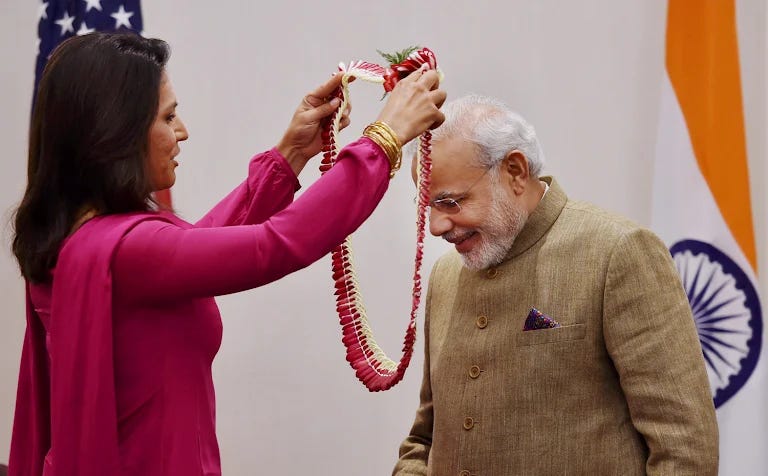
Numerous influential figures in the Trump administration are Indian nationals, have maintained direct connections to Indian political interests or have been involved in India-related lobbying efforts. Among them are:
Jayanta “Jay” Bhattacharya, former Stanford professor and national security think tank fellow, head of the National Institutes of Health, who crucially covered up the fact that life expectancy declined as a result of opioid deaths.
Trump administration National Security Advisor turned U.N. ambassador Mike Walz was the co-chair of the India Caucus in the House of Representatives before his appointment to the Trump administration.
Suzie Wiles worked as a lobbyist for India for two years until her appointment as White House Chief of Staff.
Ranjit Gill, known as “Ricky”, is a senior director for South and Central Asia on Trump’s National Security Council, where he – the grandson of an Indian officer in the British army – handles India policy
Kush Desai is White House Deputy Press Secretary
Saurabh Sharma is Special Assistant to the President for Personnel
Sriram Krishnan is a Silicon Valley venture capitalist turned Senior White House Policy Adviser on Artificial Intelligence
Anjani Sinha is U.S. Ambassador to Singapore
This phenomenon is not unique to the Trump administration. The Biden administration before it appointed roughly 130 Indians and Indian Americans to significant positions, including Rahul Gupta, who led the Office of National Drug Control Policy during the most lethal years of the opioid crisis.
The consequences of silence
The results of this geopolitical alignment are stark. China continues to restrict fentanyl production and precursor exports, while India’s role as a supplier has expanded and become normalized. Yet the U.S. political establishment has chosen to direct public attention toward a false narrative implicating Venezuela, a country that does not appear in any federal assessment of fentanyl trafficking.
By ignoring India’s growing involvement, Washington has preserved a strategic partnership at the cost of clarity, accountability, and ultimately American lives. The Trump administration’s effort to use the opioid epidemic as a justification for escalating actions against Venezuela rests on a fiction, while the underlying drivers of the crisis remain unaddressed. The United States continues to inch toward confrontation in the Caribbean, even as the real supply chains fueling the fentanyl epidemic remain intact and politically shielded.
Exceptional reporting on the regulatory gap India left open after China's class wide ban. The timing is striking how overdose deaths spiked right when India failed to adopt comparable controls on precursor chemicals, essentially filling the void China left behind. What really underscores the geopolitical blindspot here is that we've built entire foreign policy narratives around countering China while actively cultivating a partnership with a country whose regulatory failures are fueling the same crisis. The cognitive dissonace is staggering.
Important work Dan! Your chronology of distribution is stunning.